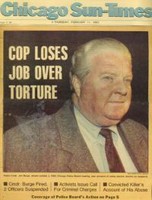
The history of Chicago leaders, police management, the establishment press being complicit for years in ignoring torture complaints by victims of police abuse is legendary . This overlooking of these torture reported incidents included allowing for a number of inmates who were innocent but who were tortured into being placed on death row. While the torture occurred under the auspices of a career police officer who reached the position of commander from the years of 1972 – 1993, there were over 110 complaints of torture by African Americans. Although Commander Jon Burge was fired in 1993, it took 18 more years, before Jon Burge was faced with jail time for any criminal activity, and as of 2/2015, he has been released from a Tampa halfway house with his annual pension intact for $54,000.
In previous blogs, I have reviewed the years of cover up by the powers to be in Chicago from the years of 1972 to 1993. This blog will detail the lengths those in power went through to keep this story under the radar from the years of 1989 to 2003. The point of this series is to stress that with this ugly history, there is no way that anyone should dare to take the word of any Chicago Police official, any establishment media reporter or any Chicago politician that there is no basis to the complaints by victims that the police at Homan Square are trampling on the their constitutional rights. The Chicago police and their defendants have not earned the benefit of the doubt. This should be a case of verify only, by those who are capable of doing an independent, competent, thorough and above board audit of the Homan Square police facility to determine if there is any validity to the 2/24 and 2/25/15 allegations of this building being run similar to a CIA “black site,” by the Guardian news outlet.
The reference for this background material is by G. Flint Taylor of Peoples Law Offices, titled, “A Long and Winding Road: The Struggle for Justice in the Chicago Police Torture Cases.” The following are some excerpts spanning the years from 1989-2003:
“Later that year (1993), the Seventh Circuit Court of Appeals reversed the verdicts in the Wilson civil rights trials, finding that Wilson had been unfairly prejudiced by the onslaught of evidence about the police murders and was entitled to present the evidence from other torture victims such as Melvin Jones and Shadeed Mumin. The case was then reassigned to District Court Judge Robert Gettleman, who ruled that the Police Board’s finding of abuse was controlling and thereby entered judgment in favor of Wilson.”
“The City, now admitting that Wilson and Jones were tortured by Burge, attempted to avoid responsibility by asserting that Burge was acting outside the scope of his employment, but this argument was rejected by the Seventh Circuit on a second appeal, and in 1997 Wilson and his lawyers obtained a $1.1 million damages and attorneys’ fees judgment.”
The Focus Shifts
“During the mid to late 1990s, the legal and activist focus shifted to the criminal courts with the emphasis on death row cases. Ten death row prisoners who all alleged that they had been tortured into giving false confessions by Burge and his men banded together to form the “Death Row Ten.”
“Activists on the outside, led by the Campaign to End the Death Penalty, the Aaron Patterson Defense Committee, and the families of the men, held demonstrations and other public events, sometimes arranging for one of the Death Row Ten to speak by telephone to the crowd. Contemporaneously, the Coalition Against the Death Penalty, and lawyers at Northwestern and DePaul were organizing against the death penalty itself, and these efforts led to Illinois Governor George Ryan’s imposition of a moratorium on executions in January of 2000.”
“A few years before, People’s Law Office lawyers had taken up the case of death row prisoner Aaron Patterson, filing a post-conviction petition that raised the wealth of torture evidence that had been uncovered since his conviction in 1989. Patterson’s case made its way to the Illinois Supreme Court, where his lawyers raised the issue of international law.”
Wilson
“At oral argument, which was filmed by a CBS “60 Minutes 2” crew for a segment on Chicago police torture, the lawyers stressed that the nature of torture mandated that the court’s previous rule requiring a criminal defendant to show physical evidence of torture in order to successfully challenge his confession should be overruled. In companion decisions handed down in the fall of 2000, the Illinois Supreme Court modified its prior rule and granted Patterson and two other Death Row Ten prisoners new hearings at which they could present evidence of systemic torture.”
Another Phase of the CPD Cover-up
“In the early 1990s, the OPS reopened a number of Area 2 torture investigations, and investigators recommended sustained findings in six cases. OPS Director Gayle Shines refused to act on the findings, and instead secreted the files in her office for five years. Ultimately, in 1998, CPD Superintendent Hillard, who had recently been appointed, and his chief counsel, Thomas Needham, summarily overruled the findings, but lawyers from the People’s Law Office were subsequently able to bring these files to light, and a front-page Chicago Tribune story followed.”
“In August 1999, a contingent of concerned public officials, activists, and organizations, led by Citizens Alert and including members of Congress, the Illinois Legislature, and the Cook County Board, formally requested that Hillard empanel an independent investigation to look into this “obvious violation of police regulations, procedure and legal process by certain OPS and the police officials during torture investigations.” Hillard met with members of the contingent, but took no action.”
“The movement against police torture also continued to demand an independent criminal investigation into the allegations of systemic torture. During the Clinton administration, a Chicago delegation, led by U.S. Rep. Bobby Rush, traveled to Washington, D.C., and met with U.S. Attorney General Janet Reno. At this meeting the pattern of police torture was emphasized as part of a plea for a wide-ranging investigation of Chicago police practices, but no federal investigation was forthcoming. Rush also held hearings in Chicago, where evidence of torture was presented.”
Appointment of a Special Prosecutor and Gubernatorial Innocence Pardons
“Frustrated by the continuing refusal to investigate and prosecute, lawyers from the MacArthur Justice Center, the Cook County Bar Association, the People’s Law Office, the Illinois Appellate Defenders Office, and the National Conference of Black Lawyers, together with Citizens Alert and the mother of an imprisoned torture victim, spearheaded a coalition that sought the appointment of a special prosecutor to investigate the allegations of systemic torture at Area 2. In April 2001, a formal petition for the appointment of a special prosecutor, alleging that the then-current state’s attorney of Cook County, Richard Devine, had a conflict of interest arising from his law firm’s previous representation of Burge in the Wilson civil rights case, was letter filed before the chief judge of the Cook County Criminal Courts, Paul Biebel. A year later, Judge Biebel found there to be a conflict, granted the petition, and appointed as special prosecutors two attorneys who were former high-ranking assistant state’s attorneys with strong connections to Richard J. Daley and his Democratic political machine.”
“The coming together of the struggles against the death penalty and police torture gathered strength in the early years of the new century, and in January 2003, Governor George Ryan, on successive days, granted innocence pardons to death row torture survivors Madison Hobley, Leroy Orange, Stanley Howard and Aaron Patterson, and then commuted the sentences of all the other men and women on Illinois’ death row to life in prison without parole.”
 Gronda Morin
Reblogged this on The Militant Negro™.
LikeLike
GRAZIE MILLE!!! Thank you for continuing to support my work.
LikeLike