
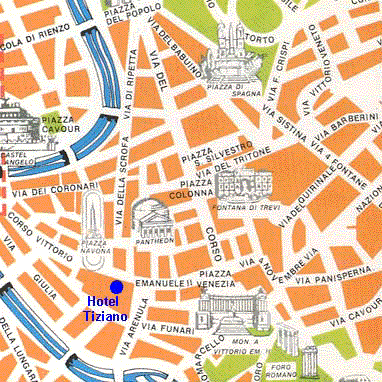
Upon settling in our Roman apartment, we set off the next morning to check out the lay of the land. If we walked a short distance west, we’d quickly reach the walkway for the Tiber River. If we walked 2 blocks east towards Via Flaminia and then continued south, we would soon find ourselves at the Piazza del Popolo, which splits at the southern section into three streets. Facing south, the center road is Via del Corso; the Via del Babuino is to the left and the Via di Ripetta is to the right. The twin churches of Santa Maria dei Miracoli (1681) and Santa Maria in Montesanto (1679), begun by Carlo Rainaldi and completed by Bernini and Carlo Fontana, define the junctions of the roads.

At a close by newspaper booth, we were able to purchase the Roma Pass (36 euros) for 72 hours which allows the holder free access to all public transit and 2 free entry tickets to any listed attraction.
Two of us got in a groove by starting our mornings at the Canova Caffe, right off to the left from the Piazza del Popolo, with a cappuccino and a crème filled croissant while sitting down at a front table. We fought off tiny bold birds from eating off our plates while watching the world pass by. Then we would take something back to our friend who liked taking her time to get ready. Before 10:00 am, we were off and running.



It was at the Forum where citizens could meet to exchange opinions. It would have been busy and loud like the street markets of today. Frequently, it was used as a place where official announcements could be proclaimed to the public. Also, it was used by adult Roman male citizen to openly share their ideas by Orating which the Romans loved. This is where politicians gave their speeches. People entering the Forum would stop and listen to anyone Orating, before they would wander away to do their shopping.
The Roman Forum was the focus of judicial activity which was moved to the new Basilica Aemilia (179 BC). Some 130 years later, Julius Caesar built the Basilica Julia, along with the new Curia Julia, refocusing both the judicial offices and the Senate itself. This new Forum, in what proved to be its final form, then served as a revitalized city square where the people of Rome could gather.
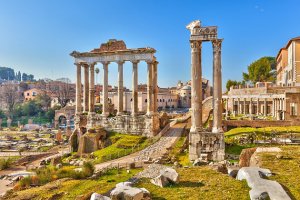
The Forum was also used for festivals and religious ceremonies.
Then we walked to the Colosseum which is the most iconic roman monument. The line was so long to enter, even with the Roma pass purchased tickets, that we were enticed by a tour company representative to skip the lines for 13 extra euros to become part of a tour group. By taking this step, we were part of a guided tour for the Colosseum and the nearby the Palantine Hill.
The tour guide described how the “Great Fire of Rome” in 64AD devastated this area to where Nero supported the construction of a grand amphitheatre which began (71-72AD). It was completed during the reign of Titus in 80AD and by 81AD when a third level had been added. A series of spaces was added beneath the arena used as a “backstage” area which has been excavated. In the 2nd century repairs were carried out and in 222 after extensive fire damage the Colosseum was completely rebuilt over the course of 30 years.

The colosseum was used for bull fights, gladiator fights, chariot races, official events and various public forms of entertainment. At its peek the most popular event was the Ludi Circenses, the chariot races, there were also naval battles reproduced with complex stage effects. Rome had a strict class system and there were 5 levels of seating within the audience according to your social status. At capacity the arena could hold 50,000 to 80,000 spectators on the marble benches.
It was awe inspiring to be able to walk almost anywhere while observing and marveling at ancient architectural wonders every few feet. I will discuss this more in my next blog.
RELATED ARTICLE:
 Gronda Morin
Reblogged this on It Is What It Is and commented:
Traveling with the ladies!!
LikeLike
Thank you for the reblog. Your support is very much appreciated!!! Finding and having good traveling buddies make the adventures more fun.
LikeLiked by 1 person
Welcome!! It’s all so interesting! Pics are great.
LikeLike
Reblogged this on The Militant Negro™.
LikeLike
Grazie Mille!!! As always, Thank you for your continued support and the reblogs.
LikeLike