
This is what Pauline Frommer in her Italian guidebook writes about Catania:
“Catania is a working- class town that relies too heavily on Mt. Etna tourism. It just doesn’t have that same sort of wonderful chaos as Palermo, nor does it possess the warm charm of Siracusa. You should only swing through Catania for a coffee break on your way up or down Mt. Etna.”
“The following is what the Lonely Planet authors in their book, “Southern Italy,” write about Mt. Etna:
“Dominating the landscape of eastern Sicily and visible from the moon (if you happen to be there), Mt. Etna is Europe’s largest volcano and one of the world’s most active. Eruptions occur frequently, both from the volcano’s four summit craters and from its slopes, which are littered with fissures and old craters. The volcano’s most devastating eruptions occurred in 1669 and lasted 122 days. Lava poured down Etna’s southern slope, engulfing much of Catania and dramatically altering the landscape. More recently, in 2002, lava flows from Mt. Etna caused and explosion in Sapienza, destroying two buildings and temporarily halting the cable car service. Less destructive eruptions have continued to occur regularly over the past decade, with 2013 seeing several dramatic instances of lava fountaining – vertical jets of lava spewing from the mountain’s southeast crater.”

“The volcano is surrounded by the huge Parco dell’Etna, the largest unspoilt wilderness remaining in Sicily. The park encompasses a remarkable variety of environments, from the severe, almost surreal, summit to deserts of lava and alpine forests.”
The southern approach to Mt. Etna presents the easier ascent to the craters. The AST bus from Catania drops you off at Rifugio Sapienza (1923m) from where a cable car runs up the mountain to 2500m. From the upper cable car station its a 3 1/2- to four hour return trip up the winding track to the authorized crater zone (2920m). Make sure you leave enough time to get up and down before the last cable car leaves at 4:45 pm. Or you can pay extra for a guided 4WD tour to take you up from the cable car to the crater zone.

An alternative ascent is from Piano Provenzano (1800m) on Etna’s northern flank. Star is a driving tour company that runs 4WD excursions between May and October to the summit from here. (347-495-7091; http://www.funiviaetna.com/star_etna_nordhtlm)”
The Lonely Planet describes the southeastern part of Sicily and Siracusa in the following terms:
“Home to Sicily’s most beautiful baroque towns and Magna Graecia’s most magnificent ancient city, the southeast is one of Sicily’s most compelling destinations. The classical charms of Syracuse (Siracusa) are reason enough to visit, but once you leave the city behind you’ll find a checkerboard of river valleys and stone walled citrus groves dotted with handsome towns. Shattered by a devastating earthquake in 1693, the towns of Noto, Ragusa and Modica are the superstars here, rebuilt in the ornate and much- lauded Sicilian baroque style that lends the region a cohesive aesthetic appeal. Writer Gesualdo Bufalino described the southeast as an island within an island and, certainly, this pocket of Sicily has a remote, genteel air – a legacy of glorious Greek heritage.”
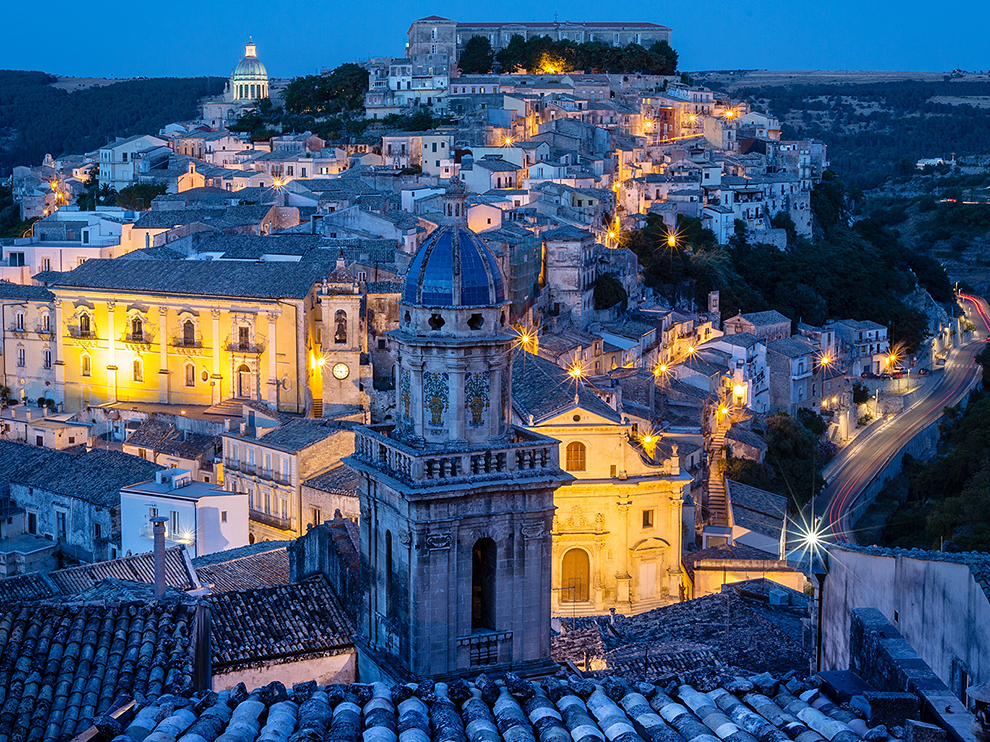
A dense tapestry of overlapping cultures and civilizations, Syracuse (Siracusa) is one of Sicily’s most appealing cities. Settled by colonists from Corinth in 734 BC, this was considered the most beautiful city of the ancient world, rivaling Athens in power and prestige. Under the demagogue Dionysius the Elder, the city reached its zenith, attracting luminaries such as Livy, Plato, Aeschylus and Archimedes, and cultivating the sophisticated urban culture that was to see the birth of the comic Greek theater.”
“As the sun set on Ancient Greece, Syracuse became a Roman colony and was looted of its treasures. While modern – day Syracuse lacks the drama of Palermo, the ancient island neighborhood of Ortygia continues to seduce visitors with its atmospheric squares, narrow alley ways and lovely waterfront, while the Parco Archaeologico della Neapolis, 2km across town, remains one of Sicily’s great classical treasures.”
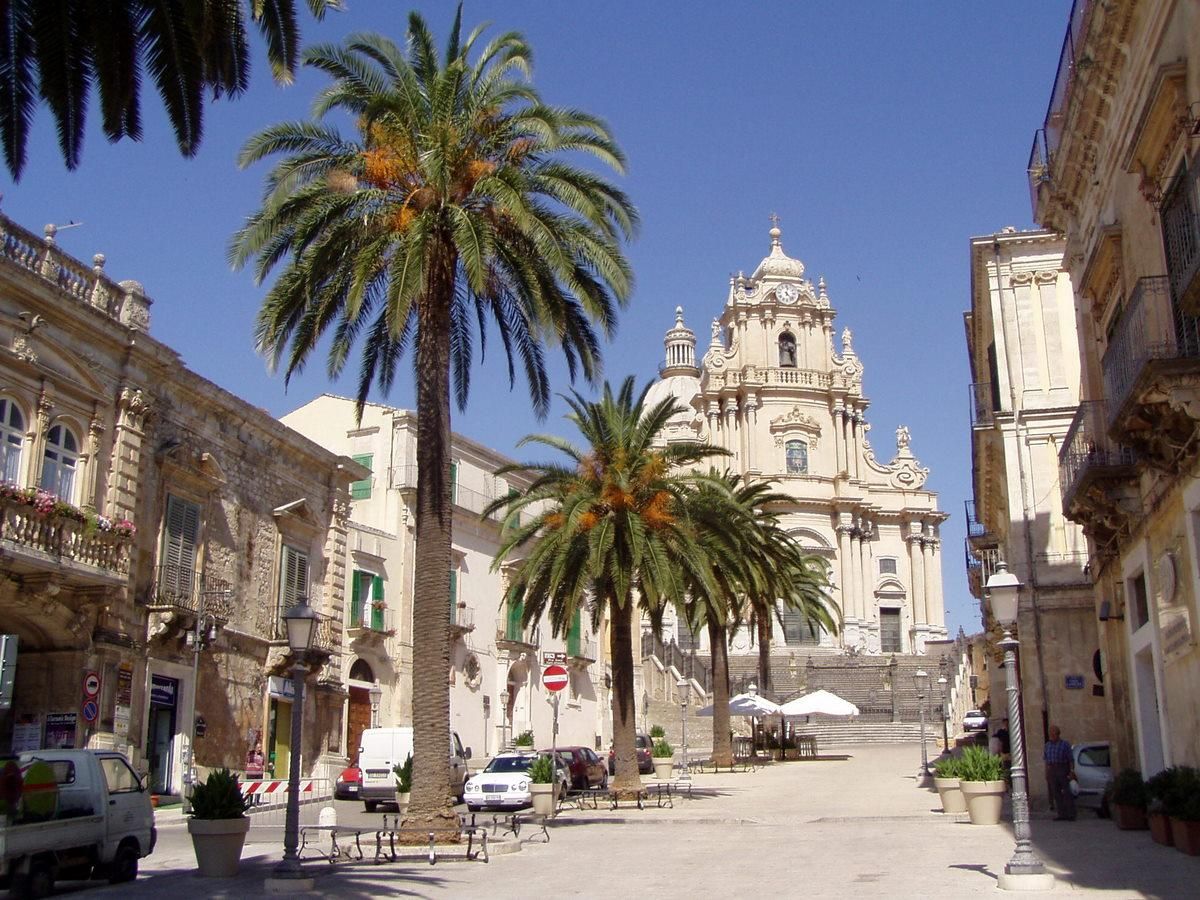
“Built on the skeleton of a 5th century BC Greek temple whose Doric columns are still visible underneath, Syracuse’s cathedral (Ortygia Duomo) was converted into a church when the island was evangelized by St. Paul. Its most striking feature is the columned façade (1728-53), added by Andrea Palma after the church was damaged in the 1693 earthquake.”
“The original temple, dedicated to Athena, was renowned throughout the Mediterranean, in part thanks to Cicero, who visited Ortygia in the 1st century BC. Its roof was crowned by a golden statue of Athena that served as a beacon to sailors at sea (nowadays replaced by a statue of the Virgin Mary). In the baptistery, look out for a 13th century font, adorned by seven bronze lions.”
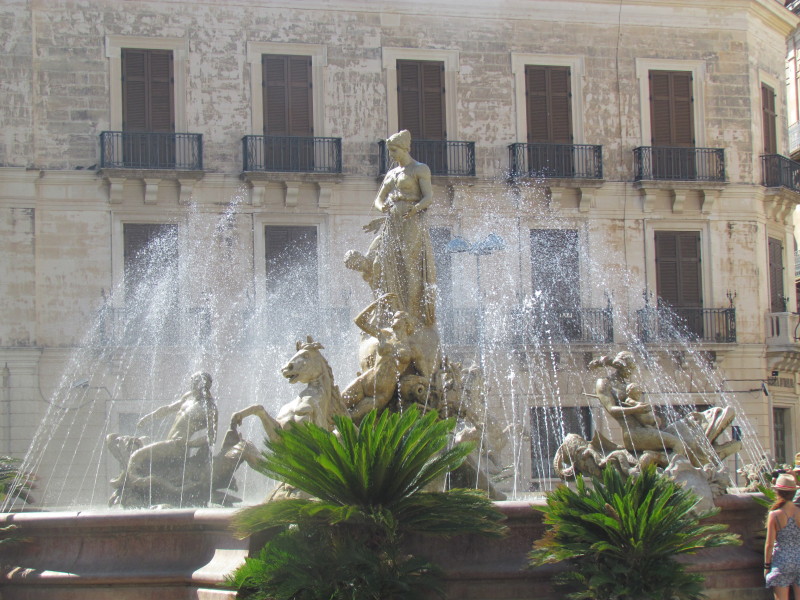
“Fontana Aretusa, an ancient spring, fresh water still bubbles up as it did 2500 years ago when this was Ortygia’s main water supply. According to the legend, the goddess Artemis transformed her beautiful hand maiden Aretusa into the spring to protect her from the river god Alpheus.”
“Housed in a 13th century Catalan-Gothic palace, the Galleria Regionale di Palazzo Bellomo art museum’s eclectic collection ranges from early Byzantine and Norman stonework to 19th century Caltagirone ceramics; in between, there’s a good range of medieval religious paintings and sculpture.”

“Guarding the island’s southern tip, Ortygia’s 13th century castle is a lovely place to wonder, gaze out over the water and contemplate Syracuse’s past glories. It also hosts occasional rotating exhibitions.”
Simply walking through Ortygia’s tangled maze of alleys is an atmospheric experience, especially down the narrow lanes of Via Maestranza, the heart f the old guild quarter, and the crumbling Jewish ghetto of Via della Giudecca.”
RELATED ARTICLES:
Hiking Italy, Volcano to Volcano – The New York Times http://www.nytimes.com/…/hiking-italy-volcano-to-volca…Jul 19, 2012 – Mount Etna during an eruption in April. … Show up early (that means 8 p.m. here) or reserve; 30 euros a person without wine. … The trip up takes about two and a half to three hours, factoring in a few rest stops. … There are several tour companies in town, including Il Vulcano a Piedi (Via Roma in front of the…
Etna Excursions and Etna Tour to Volcano Etna – Go-Etna http://www.go-etna.com/jeep-excursion-to-mount–etna/ Jeep tours, Etna excursions to Mount Etna, Visit the highest volcano in Europe trough lava … At the end of the tour we will drive you back to your accommodation.


Reblogged this on It Is What It Is and commented:
This upcoming adventure keeps getting better and better!! Awesome pictures …. awesome place!!
LikeLike
GRAZIE MILLE. As always, thanks for the reblog and for your support. I am waiting to see what the court dictates regarding Kim Davis.
LikeLike