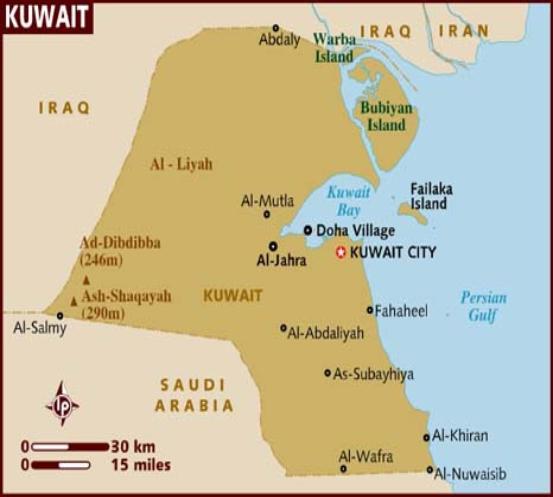
Quick cliff notes are: Kuwait of the Middle East, borders on the Persian Gulf, between Iraq and Saudi Arabia.
The population is about four million with immigrants accounting for almost 69% (2015). The level of literacy is high to where 96% of nationals over 15 can read and write. For governing, the emir is chosen from within the ruling family and confirmed by the National Assembly. The prime minister and deputy prime ministers are appointed by the emir. In the cabinet, the Council of Ministers are appointed by the prime minister, but approved by the emir.
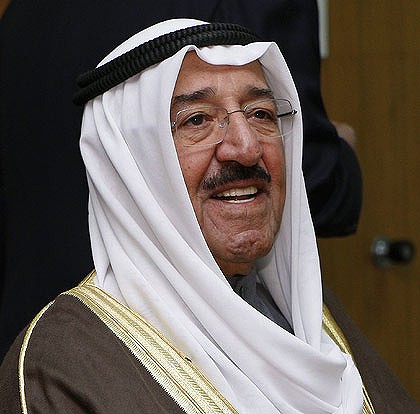
The Chief of state is Emir Sabah al-Ahmad al-Jabir al-Sabah (since January 2006); Crown Prince NAWAF al-Ahmad al-Jabir al-Sabah is the half-brother of the Emir of Kuwait (born June 1937); the head of government is Prime Minister Jabir Al-Mubarak al-Hamad al-Sabah (since November 2011); First Deputy Prime Minister is Sabah Khaled al-Hamad al-Sabah; Deputy Prime Ministers are Khaled al-Jarrah al-Sabah, Muhammad al-Khalid al-Hamad al-Sabah, Abdulmohsen Medej. (resigned in March 2015)
BBC News published on 7/1/15, an overview profile on the Middle East section which is as follows:
“Politics: After years of clashes between the elected parliament and the ruling family, the opposition boycotted elections in 2012; the country has faced violence from militant Islamists.”
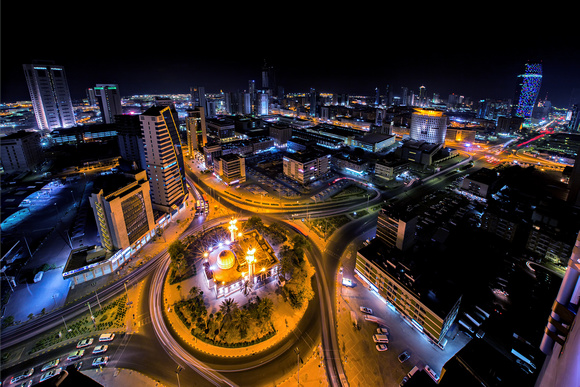
“Economy: Kuwait is one of the world’s leading oil producers.” (It has not become as financially diversified as many of the other Persian Gulf states because of dysfunctional governing.)
“International: Kuwait was invaded and occupied by Iraq in 1990; it served as a springboard for the invasion of Iraq in 2003.”
“Kuwait is a small, oil-rich country nestling at the top of the Gulf, flanked by large or powerful neighbours – Saudi Arabia to the south, Iraq to the north and Iran to the east.”
“Its oil fields were first exploited in the 1930s, and since the development of the petroleum industry after World War II and independence in 1961, oil has dominated the economy, making up around 90% of export revenues.”

“In 1991, the country was the scene of a massive US-led international military campaign to oust Iraqi forces, which had invaded the year before. Operation Desert Storm saw their eventual removal, but Kuwait’s infrastructure was left in bad shape and had to be rebuilt. Oil exports stopped for a time.”
“Twelve years later, Kuwait played host to another massive military presence as thousands of soldiers massed on the Iraqi border for the US-led campaign in 2003 to disarm and oust the Iraqi leader Saddam Hussein.”
“Kuwait was the first Arab country in the Gulf to have an elected parliament. Moves to change the male-dominated political structure culminated in the granting of full political rights to women in 2005.”
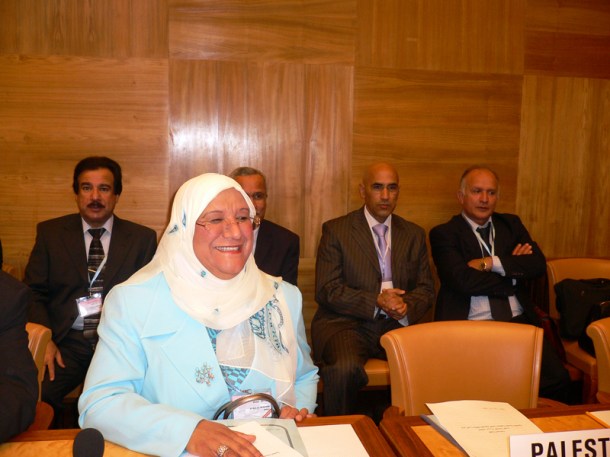
“In May of that year, (2005) parliament gave women the right to vote and stand as candidates in elections for the 50-seat National Assembly.”
More generally, the growing assertiveness of parliament has led to frequent confrontations with the government, especially after Islamists made major gains at elections in February 2012. The annulment of those elections and subsequent changes to the election law prompted an opposition boycott of fresh polls in December 2012, putting Kuwait’s relatively liberal political credentials in doubt.
“Despite large oil revenues, the economy has been badly affected by the global financial crisis. Economic policy-making has been held back by disputes between the ruling royal family and parliament.”
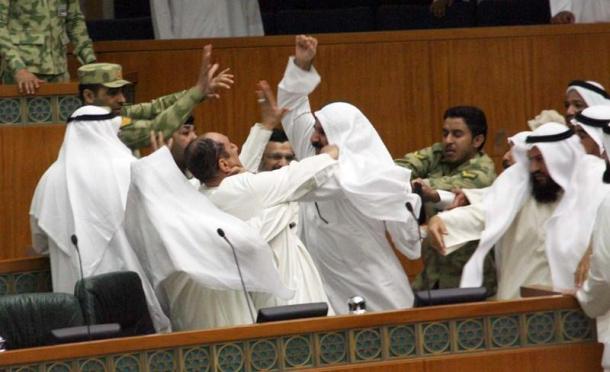
The 3/25/15 Daily Mail.com provides an example of the dysfunction within their governing body with the following commentary:
“Kuwaiti Commerce and Industry Minister Abdulmohsen al-Mudej resigned Wednesday (3/25), two days after an MP called for him to be questioned in parliament, the second such case in as many weeks.”
“The official KUNA news agency said the emir accepted the resignation of Mudej, a liberal, Western-educated minister appointed in January 2014.”
“Last week, Electricity, Water and Public Works Minister Abdulaziz al-Iraheem quit after he had indirectly accused some lawmakers of taking bribes to grill him.”
“No reason was cited by KUNA for the resignation of Mudej, who was also deputy premier.”
“But MP Roudhan al-Roudhan filed a request on Monday to grill the minister for allegedly violating the commercial law.”

“The lawmaker held Mudej responsible for not forcing the board of directors of a local company to hold a meeting, resulting in heavy losses for small shareholders.”
“Mudej, 66, was Kuwait’s oil minister between 1994 and 1996, and he also served as a member of parliament between 1992 and 2003.”
“The minister was grilled in parliament last year over alleged financial and administrative violations, but he denied all the charges and remained in his post.”

- Kuwaiti Leaders
The following information is from the CIA World Factbook:
General information
“Britain oversaw foreign relations and defense for the ruling Kuwaiti AL-SABAH dynasty from 1899 until independence in 1961. Kuwait was attacked and overrun by Iraq on 2 August 1990. Following several weeks of aerial bombardment, a US-led, UN coalition began a ground assault on 23 February 1991 that liberated Kuwait in four days. Kuwait spent more than $5 billion to repair oil infrastructure damaged during 1990-91. The AL-SABAH family has ruled since returning to power in 1991 and reestablished an elected legislature that in recent years has become increasingly assertive. The country witnessed the historic election in 2009 of four women to its National Assembly.”

“Amid the 2010-11 uprisings and protests across the Arab world, stateless Arabs, known as bidun, staged small protests in February and March 2011 demanding citizenship, jobs, and other benefits available to Kuwaiti nationals. Youth activist groups – supported by opposition legislators – rallied repeatedly in 2011 for the prime minister’s dismissal amid allegations of widespread government corruption. Demonstrators forced the prime minister to resign in late 2011. In late 2012, Kuwait witnessed unprecedented protests in response to the Amir’s changes to the electoral law by decree reducing the number of votes per person from four to one. The opposition, led by a coalition of Sunni Islamists, tribalists, some liberals, and myriad youth groups, largely boycotted legislative elections in 2012 and 2013 ushering in legislatures more amenable to the government’s agenda. Since 2006, the Emir has dissolved the National Assembly on five occasions (the Constitutional Court annulled the Assembly in June 2012 and again in June 2013) and shuffled the cabinet over a dozen times, usually citing political stagnation and gridlock between the legislature and the government.”

Economy
 Gronda Morin
Reblogged this on It Is What It Is and commented:
Middle East education continues … Kuwait.
LikeLike
GRAZIE MILLE! I am very grateful for your support and thanks for this reblog. I made sure to verify the Roman numerals before I posted this blog.
LikeLike