 Today, February 8, 2024, the US Supreme Court justices will be hearing oral arguments for and against the 14th amendment, section 3 regarding the case Trump v. Anderson. They’ll be deciding whether to affirm the State of Colorado’s Supreme Court’s ruling stating that Colorado’s election laws permit it to disqualify the GOP MAGA ex-president from being on the ballot to become US president because he had been a leading participant during, before and post the January 6, 2021 insurrection against the US capitol in an attempt to thwart the 2020 pro-forma presidential electoral college vote counting. This formality had already been a “fait accompli,” 306 electoral votes for the democrat US President-elect Joe Biden and 232 for the outgoing occupant of the White House, Donald Trump.
When the U.S. Supreme Court accepted this case on Jan. 5, 2024, it decided to limit its review to one question: “Did the Colorado Supreme Court err in ordering President Trump excluded from the 2024 presidential primary ballot?”
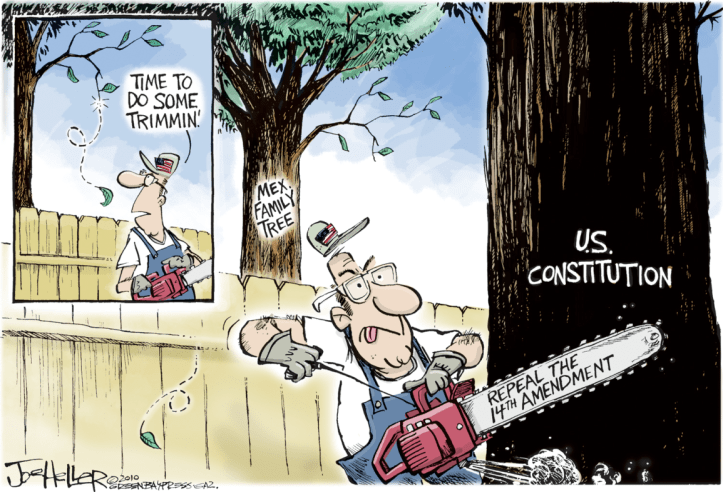
The State of Colorado has determined that the insurrectionist ex-president has disqualified himself from becoming the next US president because he failed to honor his oath as the top US governmental official who upon his taking office, swore an oath, “I will to the best of my ability, preserve, protect and defend the Constitution of the United States.” Any US citizen under 35 years old, or who hasn’t been a US citizen at birth or who has already served 2 four-year terms as US president, would also be disqualified.
This Supreme Court hearing regarding the 14th amendment, section 3 has garnered lots of interest from the American public as well as from legal scholars, political activists, etc. Cable news shows like MSNBC, C-Span plan on live streaming the 2-hour hearing starting around 10 am eastern time.
Link by National Constitution Center: Listen to the Live Arguments

There have been about 78 amicus briefs filed by interested parties.
As per a February 6, 2024 Yahoo News item, “More than 78 ‘friends’ of the Supreme Court offer advice on the 14th Amendment and Trump’s eligibility” by Wayne Unger, Quinnipiac University:
Excerpts:
“As with many cases before appellate courts, and especially those before the Supreme Court, outside interested parties can file what are called an amicus brief. The filers are referred to as “amicus curiae,” Latin for a “friend of the court.” They are not a party to the case but rather someone or a group who volunteer advice in a case before the court.”
“The purpose of amicus briefs varies. They can be used to share specialized knowledge with the courts. In their Trump v. Anderson amicus brief, constitutional law scholars Akhil Reed Amar of Yale Law School and Vikram David Amar of University of California, Davis, School of Law write about the history and significance of the first insurrection, which occurred in the 1860s. They describe this as an effort to “prevent the lawful inauguration of duly elected Abraham Lincoln.”
“Others file amicus briefs to advance or further an argument. Some may discuss the potential effects of possible decisions. All share a common thread: Amicus briefs are filed to help the court shape the ruling in the case.”


3.) Within the pages of the Colorado state court‘s 4-3 ruling, there’s a reference to the conservative Supreme Court’s Justice Neil Gorsuch’s earlier 2012 ruling when he was a circuit court of appeals judge. He had ruled that “it’s a state’s legitimate interest in protecting the integrity and practical functioning of the political election process’ that ‘permits it to exclude from the ballot candidates who are constitutionally prohibited from assuming office.” This case concerned a long-shot presidential candidate’s citizenship status.
How does the Supreme Court Justice Gorsuch of today, justify a ruling that takes away the power of the State of Colorado to make well-reasoned decisions based on its own election statutes to disqualify a candidate from seeking political office? As per the December 20, 2023 Business Insider report, “Colorado court used Supreme Court Justice Neil Gorsuch’s ruling to justify disqualifying Trump” by Brent D. Griffiths and Paul Squire:
Excerpts:
“In 2012, Gorsuch dealt with a far less weighty case. It is worth pointing out that his decision is not even three pages long.”
“Still, the appeals court was asked to consider whether then-Colorado Secretary of State Scott Gessler had acted properly when his office decided that Abdul Hassan, an independent candidate for president, could not be on the state’s ballot because Hassan was ineligible to be president. Hassan, who was born in Guyana, was a naturalized citizen but in Colorado’s view, he was not a natural-born citizen. While the Supreme Court has never definitely ruled on the phrase, it has been taken to mean that a candidate must be born on US soil or born to a parent who is an American citizen.”

Originalism is a conservative judicial philosophy that maintains that the only legitimate way to decide constitutional disputes is to ask how they would have been resolved when the Constitution was drafted. Textualism limits jurists to base their rulings only on what’s written in the text of a statute without consideration to public outcries.

 Gronda Morin
Back in the day when we had a relatively honest Supreme Court dedicated to upholding the U.S. Constitution, I would have said this is a no-brainer and SCOTUS will do the right thing, rule that under the 14th Amendment, Trump is ineligible to be on the ballot. But, with recent evidence of corruption by several members of the Court, I find that my trust and faith in them to do the right thing has waned, if not vanished altogether.
LikeLiked by 1 person
Dear Jill,
Unfortunately, I share your lack of faith in the US Supreme Court justices’ ability to simply do what is right.
I listened to the hearing, the questions and answers, and you are right. What the conversations tell us, is that this Supreme Court will be ruling against Colorado. Frankly, this was a disastrous day for Colorado. The justices were looking for any way to not decide in favor of Colorado.
I’m disheartened, especially after listening to the ex-president’s response to this hearing.
Hugs, Gronda
LikeLiked by 1 person
Hi Gronda …
Yes, SCOTUS has lost our trust and it will take a lot to rebuild it. I did not listen to the hearing today, but read about it in several venues and it appears that the Justices will be overruling the Colorad Supreme Court and allowing Trump on the ballot in all 50 states. I, too, am disheartened … to the point of struggling for anything to write about tonight, for I am so very sick of writing about Trump.
Hugs
LikeLiked by 1 person
IF the Supreme Court rules against the State of Colirado, someone needs to challenge the validity of the Court itsef, as such a ruling should constitute an act of insurrection against the Democracy of the United States of America itself.
LikeLiked by 1 person