Voters should ask business and political leaders, why the USA isn’t the richest country in the world when it produces the most goods and services in a year by far, when compared to other nations? If a country’s wealth is based only on GDP (gross domestic product), then the United States is the richest. But it is the GDP per capita which is when a country’s (GDP) gross domestic product output gets divided by the number of full-time residents that is also widely utilized to determine how rich or poor a country’s population is relative to others. Based on the GDP per capita definition, the USA didn’t rank in the top 10 until 2020. Depending on how these numbers get evaluated, the US ranks anywhere from 7th to 9th as the wealthiest.
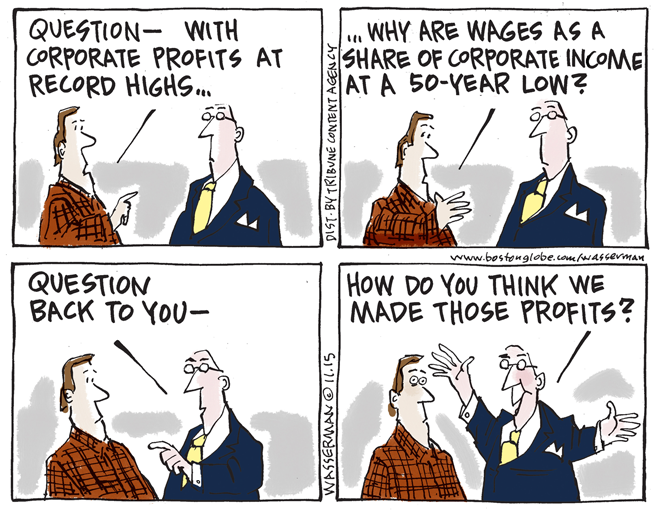
The reason for this is income inequality. While US workers’ wages have stagnated for 50 years as companies increased productivity and CEO compensation increased by over 1,322%, the disparity in income between the wealthy and essential workers widened.
The paradigm of businesses being so laser focused on profitability with the goal of increasing returns to already rich shareholders, at the expense of average workers seeing improvement in their working conditions and living wages for over 50 years is how companies have been contributing to widespread economic, gender and racial inequalities, and in hastening climate breakdown. Rich folks have gotten a lot richer while laborers’ wages have not even kept up with inflation.

Since 1973, after the formation of ALEC (American Legislative Exchange Council), member corporations have created policies and template laws designed to drive down wages, dodge paying their fair share in taxes, promoting climate science denialism, while consistently, influencing governments to privatize vital public services like healthcare and education.
In short, the model of a successful, well-managed company can no longer be defined solely by optimizing its bottom line. This mindset is responsible for the USA being the 7th or 9th richest country instead of number one.
This is especially true with the AI revolution about to take off which supposedly will increase GDP numbers dramatically, at the expense of jobs. There’ll have to be a plan to adequately compensate unemployed essential workers during this time of transition.
See: Understanding the Historic Divergence Between Productivity and a Typical Worker’s Pay/ EPI 2015…
See: POTUS Biden Is Working to Lift Up All Including GOP MAGAs/ ALEC Explained
World’s Richest Countries 2024
| Rank | Country/Territory | GDP-PPP per capita ($) |
| 1 | 🇱🇺Luxembourg | 143,743 |
| 2 | 🇲🇴Macao SAR | 134,141 |
| 3 | 🇮🇪Ireland | 133,895 |
| 4 | 🇸🇬Singapore | 133,737 |
| 5 | 🇶🇦Qatar | 112,283 |
| 6 | 🇦🇪United Arab Emirates | 96,846 |
| 7 | 🇨🇭Switzerland | 91,932 |
| 8 | 🇸🇲San Marino | 86,989 |
| 9 | 🇺🇸United States | 85,373 |
| 10 | 🇳🇴Norway | 82,832 |
| 11 | 🇬🇾Guyana | 80,137 |
| 12 | 🇩🇰Denmark | 77,641 |
| 13 | 🇧🇳Brunei Darussalam | 77,534 |
| 14 | 🇹🇼Taiwan | 76,858 |
| 15 | 🇭🇰Hong Kong SAR | 75,128 |
| 16 | 🇳🇱Netherlands | 74,158 |
| 17 | 🇮🇸Iceland | 73,784 |
| 18 | 🇸🇦Saudi Arabia | 70,333 |
| 19 | 🇦🇹Austria | 69,460 |
| 20 | 🇸🇪Sweden | 69,177 |
| 21 | 🇦🇩Andorra | 69,146 |
| 22 | 🇧🇪Belgium | 68,079 |
| 23 | 🇲🇹Malta | 67,682 |
| 24 | 🇩🇪Germany | 67,245 |
| 25 | 🇦🇺Australia | 66,627 |
| 26 | 🇧🇭Bahrain | 62,671 |
| 27 | 🇫🇮Finland | 60,851 |
| 28 | 🇨🇦Canada | 60,495 |
| 29 | 🇫🇷France | 60,339 |
| 30 | 🇰🇷South Korea | 59,330 |
| 31 | 🇬🇧United Kingdom | 58,880 |
| 32 | 🇨🇾Cyprus | 58,733 |
| 33 | 🇮🇹Italy | 56,905 |
| 34 | 🇮🇱Israel | 55,533 |
| 35 | 🇦🇼Aruba | 54,716 |
| 36 | 🇯🇵Japan | 54,184 |
| 37 | 🇳🇿New Zealand | 53,797 |
| 38 | 🇸🇮Slovenia | 53,287 |
| 39 | 🇰🇼Kuwait | 52,274 |
| 40 | 🇪🇸Spain |
The May 3, 2024 Global Finance Magazine report better explains this broader richest country’s definition by Luca Ventura, “Richest Countries in the World 2024:
“But what do we mean when we say a country is “rich,” especially in an era of growing income inequality between the super-rich and everyone else? While gross domestic product (GDP) measures the value of all goods and services produced in a nation, dividing this output by the number of full-time residents is a better way of determining how rich or poor one country’s population is relative to another’s.”

“However, only when taking into account inflation rates and the cost of local goods and services can we get a more accurate picture of a nation’s average standard of living: the resulting figure is what is called purchasing power parity (PPP), often expressed in international dollars to allow comparisons between different countries.”
“Should we then automatically assume that in nations where PPP is particularly high the overall population is visibly better off than in most other places in the world? Not quite. We are dealing with averages and within each country structural inequalities can easily swing the balance in favor of those who are already advantaged.”

“The COVID-19 pandemic lifted the veil on these disparities in ways few could have predicted. While there’s no doubt that the wealthiest nations—often more vulnerable to the coronavirus due to their older population and other risk factors—had the resources to take better care of those in need, those resources weren’t equally accessible to all. Furthermore, the economic fallout of lockdowns hit low-paid workers harder than those with high-paying occupations and that, in turn, fueled a new kind of inequality between those who could comfortably work from home and those who had to risk their health and safety by traveling to job sites. Those who lost their jobs because their industries shut down entirely found themselves without much of a safety net—large holes in the most celebrated welfare systems in the world were exposed.”
“Then as the pandemic subsided, inflation surged globally, Russia invaded Ukraine, exacerbating the food and oil price crisis. The Israel-Hamas followed, bringing more disruption to supply chains and commodity and energy markets. Lower-income families tend to be hit the hardest, as they’re forced to spend greater proportions of their incomes on basic necessities—housing, food, transportation.”

Benefits of addressing the issue of income inequality…
As per the January 19, 2020 World Economic Forum, “Revealed: Why Economies Benefit from Fixing Inequality:
“The World Economic Forum’s inaugural Social Mobility Report finds that increasing social mobility, a key driver of income equality, by 10% would not only benefit social cohesion but also boost economic growth by nearly 5% over the next decade.”
·”Across the Global Social Mobility Index, only a handful of nations have put in place the right conditions to foster social mobility.”
·”The top 5 are all Scandinavian, while the 5 economies with the most to gain from boosting social mobility are China, the United States, India, Japan and Germany.”
·”Four dimensions emerge as priorities for improving social mobility globally: fair wages; social protection; lifelong learning; and better working conditions.”
· Read the report here

“Davos-Klosters, Switzerland, 20 January 2020 – Creating societies where every person has the same opportunity to fulfil their potential in life irrespective of socioeconomic background would not only bring huge societal benefits in the form of reduced inequalities and healthier, more fulfilled lives, it would also boost economic growth by hundreds of billions of dollars a year. This is the key finding from the World Economic Forum’s Social Mobility Report 2020.”
“The report measures 82 economies against five key dimensions, distributed over 10 pillars, that are necessary for creating social mobility. These are: Health; Education (access, quality and equity); Technology; Work (opportunities, wages, conditions); and Protections and Institutions (social protection and inclusive institutions).”
“A common theme in the report is that few economies have adequate conditions to foster social mobility. As a consequence, inequality has become entrenched and is likely to worsen amidst an era of technological change and efforts towards a green transition. The report identifies four key areas among the 10 pillars where progress – across both developed and emerging economies – is particularly lagging: low wages; lack of social protection; inadequate working conditions; and poor lifelong learning systems for workers and the unemployed.”
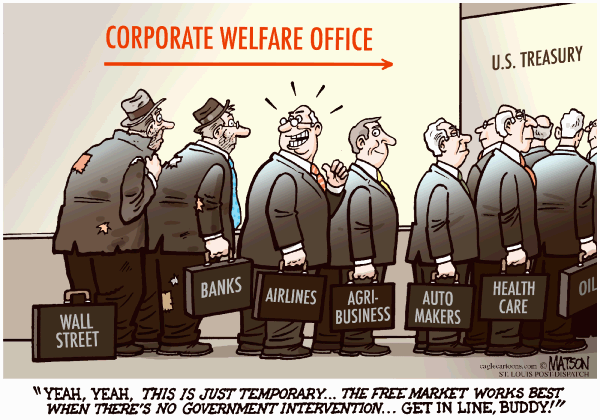
“The social and economic consequences of inequality are profound and far-reaching: a growing sense of unfairness, precarity, perceived loss of identity and dignity, weakening social fabric, eroding trust in institutions, disenchantment with political processes, and an erosion of the social contract. The response by business and government must include a concerted effort to create new pathways to socioeconomic mobility.”
“The economic return from lifting social mobility across the board is considerable. According to the report, if economies were able to improve their social mobility score by 10 points, GDP would increase by 4.4% by 2030 on top of the societal benefits such investments would bring.”
“Further, the report warns that while social mobility requires a new set of public investments, it is the mix and quality of investments that will make them effective, and they must be paired with shifts in business practices. Improving social mobility is a multistakeholder challenge, in which businesses must also take the lead by promoting a culture of meritocracy in hiring, providing vocational education, reskilling, upskilling, improving working conditions and paying fair wages.”
Social mobility in 2020
“The most socially mobile societies in the world, according to the report’s Global Social Mobility Index, are all European. In the inaugural year of the report, the Nordic nations hold the top five spots, led by Denmark in first place (scoring 85 points), followed by Norway, Finland and Sweden (all above 83 points) and Iceland (82 points). Rounding out the top 10 are the Netherlands (6th), Switzerland (7th), Austria (8th), Belgium (9th) and Luxembourg (10th).”

“Among the G7 economies, Germany is the most socially mobile, ranking 11th with 78 points, followed by France in 12th position. The US is (27th) and Italy (34th).”
“The report makes a powerful case for stakeholder capitalism. The most socially mobile economies all share an emphasis on effective social policies that benefit communities as well as provide a platform for healthy, competitive economies. By comparison, economies that are organized more on “shareholder value maximization”, or “state capitalism”, tend to perform less well.”
 Gronda Morin
[…] Businesses Contribution to Income Inequality Is Why USA is 9th Richest Country, Not #1 […]
LikeLiked by 1 person
Dear Ned,
I’m so appreciative of your support and for reposting my blog.
I’m convinced that income inequality will continue to widen if the GOP MAGA ex-president should squeak out a win.
Hugs, Gronda
LikeLike