The following information for this blog is compiled from a PBS documentary:
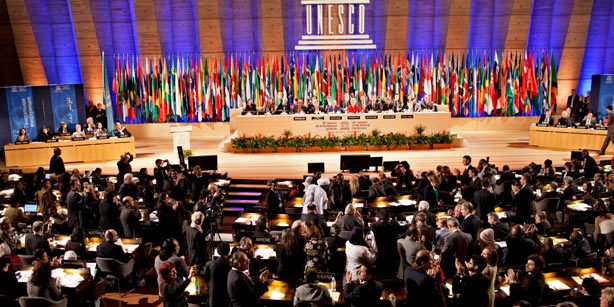
Oct. 31, 2011 Palestine Becomes 195th Full Member of UNESCO, US Pulls Annual $70 Million Contribution
“Palestine became the 195th full member of Unesco on 10/31/11, as the United Nations organization defied a mandated cutoff of American funds under federal legislation from the 1990s. The vote of Unesco’s full membership was 107 to 14, with 52 abstentions.
The step will cost the United Nations Educational, Scientific and Cultural Organization one-quarter of its yearly budget — the 22 percent contributed by the United States (about $70 million) plus another 3 percent contributed by Israel. Victoria Nuland, a State Department spokeswoman, said that American contributions to Unesco, including $60 million scheduled for this month, would not be paid.

Cheers filled the hall at Unesco’s headquarters here after the vote, with one delegate shouting, ‘Long live Palestine!’ in French. The Palestinian foreign minister, Riad al-Malki, praised the organization, saying that ‘this vote will help erase a tiny part of the injustice done to the Palestinian people’ and that it would help protect world heritage sites in Israeli-occupied territory. In a long speech, Mr. Malki said that ‘this membership will be the best step toward peace and stability,’ insisting that the Palestinian request for membership in Unesco was ‘linked in no way to our request to join the United Nations.”
Nov. 11, 2011 Palestinian Statehood Bid Stalls after UN Security Council Fails to Vote
“The Palestinian bid for statehood at the United Nations was effectively stalled Friday after the Security Council approved a report stating its inability ‘to make a unanimous recommendation.’

‘We knew from the beginning … that we might not be able to succeed in the Security Council because there is a powerful country that has the veto power,’ said Riyad Mansour, the Palestinian envoy to the United Nations. He said that he believed the report was ‘objective.’ The United States has been vocal about its intention to veto any Palestinian bid for statehood. Last week, France and the United Kingdom said they would abstain from the vote. Those three nations, along with China and Russia, have veto power in the Security Council…
Were a council resolution to pass, the membership bid would be forwarded to the General Assembly, where passage is all but assured. A vote in the near term does not seem likely. But should it take place, diplomats say that the Palestinians are unlikely to get even the nine votes necessary for a resolution to pass, because of a large number of abstentions. The U.S. veto would effectively be moot…
The next step for the Palestinians remains unclear. They could sidestep the Security Council and go straight to the General Assembly, where they would get an upgraded observer status, matching that of the Vatican, but not full membership. Palestinian Authority President Mahmoud Abbas, however, has said that they will not pursue that option.”
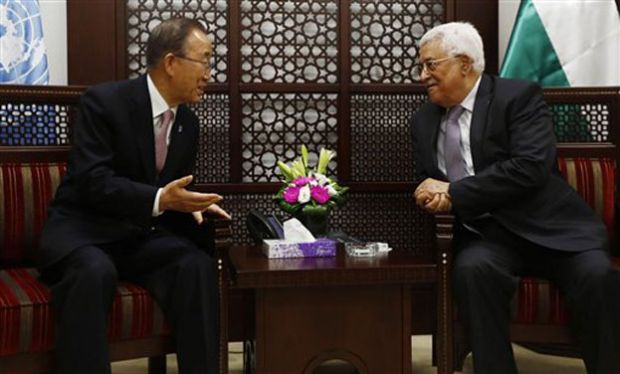
Jan. 25, 2012 Israeli-Palestinian Peace Talks in Jordan End Without Progress
“The Palestinian Authority president has said the exploratory talks with Israel on resuming full peace negotiations have concluded, without any progress…
Palestinian and Israeli negotiators met five times in recent weeks in the Jordanian capital for what were termed ‘exploratory talks.’… The Quartet of Middle East peace mediators – the US, UN, EU and Russia – said last autumn that they expected both sides to submit detailed proposals on borders and security arrangements, in the hope that the dialogue would encourage the resumption of direct peace talks…
Palestinian negotiators insist that building settlements on occupied land must stop before they agree to reopen talks. Israel says there can be no preconditions to talks and it continues to build in the settlements.”

May 7, 2012 Israeli PM Netanyahu Forms New Coalition Government With Opposition Leader, Pledging a Renewal of Peace Process


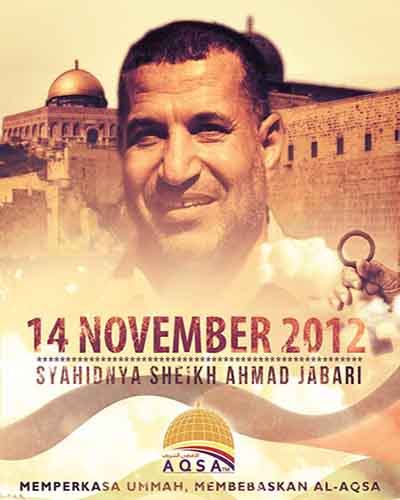 Israel’s offensive on Gaza began with an air strike that killed the commander of Hamas’s military wing, Ahmed Jabari, whom it accused of responsibility for ‘all terrorist activities against Israel from Gaza’ over the past decade. The Israel Defense Forces (IDF) subsequently announced the start of Operation Pillar of Defense, which it said was intended to protect Israeli civilians from rockets and mortars fired by militants in Gaza, as well as cripple Hamas’s capability to launch attacks. Israeli Prime Minister Benjamin Netanyahu said the operation was launched because he could no longer ‘accept a situation in which Israeli citizens are threatened by the terror of rockets…’ Although Jabari’s killing signaled the start of Israel’s offensive, it was preceded by spates of deadly cross-border violence which saw Palestinian militant groups, including Hamas’s Qassam Brigades, firing hundreds of rockets into southern Israel and the Israeli military shelling Gaza and carrying out air strikes… Mr. Netanyahu has insisted that he is not seeking to topple Hamas.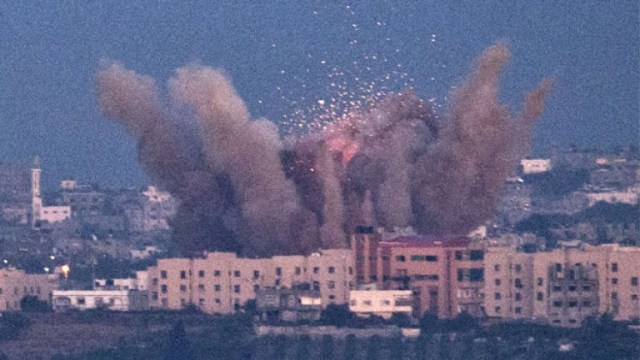
 Gronda Morin
Reblogged this on The Militant Negro™.
LikeLike
GRAZIE MILLE!! As always, thanks a million for your support and for this reblog.
LikeLike
Reblogged this on It Is What It Is and commented:
The Israeli-Palestinian conflict … our education continues!
LikeLike
Grazie mille!! I can’t thank you enough for all your support and for this reblog.
LikeLiked by 1 person
Always, dear friend!!
LikeLike