
This is the most important decision to be decided by the Supreme Court justices since the “voting rights” and the “Citizens’ United” cases. Let’s hope the justices get this one right.
Wisconsin is a case of gerrymandering gone amok. The election after the current gerrymandering map of voting districts, Republicans earned just a 48.6 percent of the statewide vote, but captured a 60-to-39 seat advantage in the State Assembly.
In the past, the Supreme Court has resisted rendering rulings on cases involving gerrymandering, but this is a case of gerrymandering which appears to have grievously negated the votes of many of its peoples, and this time, there is a way to measure the impact of gerrymandering (“efficiency gap”) that is patently unfair.
 Here’s the rest of the story…
On June 19, 2017, Robert Barnes of the Washington Post penned the following report, “Supreme Court to hear potentially landmark case on partisan gerrymandering.”
Excerpts:
“In the election held after the new district maps were adopted (2012/ 2014), Republicans got just 48.6 percent of the statewide vote, but captured a 60-to-39 seat advantage in the State Assembly.But the Supreme Court has long been tolerant of partisan gerrymandering — and some justices have thought that the court shouldn’t even be involved. A finding otherwise would have a revolutionary impact on the reapportionment that will take place after the 2020 election and could come at the expense of Republicans, who control the process in the majority of states.”
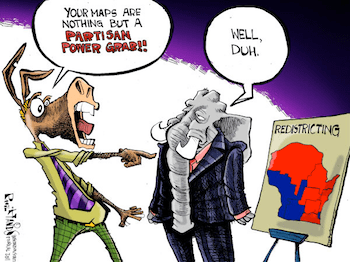 “In the Wisconsin case, plaintiffs urged the use of a measure called the “efficiency gap” to determine how Republican mapmakers hurt Democrats with the main tools of gerrymandering: “packing” and “cracking.” These refer to packing like-minded voters, such as supporters of the same party, into a limited number of districts or cracking their influence by scattering them across districts in numbers too small to make an impact.”
“Under the approach, developed by two University of Chicago professors, every voter packed into a district above the threshold needed to elect a candidate from his party creates a “surplus” vote. And someone in a cracked district who votes for a candidate who is unable to win is a “lost” vote. Surplus and lost votes are considered wasted votes.”
“The efficiency gap measures the difference between the wasted votes of the two parties in an election divided by the total number of votes cast.”
“The federal court in Wisconsin was not so definitive. It acknowledged the efficiency gap, but only as one of several theories the court said corroborated its findings that the Republican leadership had a discriminatory intent, that its plan had a discriminatory effect and that the state had no legitimate reason for drawing the districts in the way it did.”
“The state contends that while Wisconsin is a purple state in national elections, its geography favors Republicans in legislative elections. Democratic voters are clustered in cities such as Milwaukee and Madison, while Republican voters are more evenly spread across the state. Any method of drawing districts will favor Republicans, they say.”
The case is Gill v. Whitford.
On June 19, 2017, Patrick Marley of the Milwaukee Journal Sentinel penned the following report, U.S. Supreme Court to hear Wisconsin’s redistricting case but blocks redrawing of maps.” (For the entire, more detailed report see link below.)
Supreme court decision on gerrymandering
” The U.S. Supreme Court agreed Monday to hear a case that found Wisconsin Republicans overreached in 2011 by drawing legislative districts that were so favorable to them that they violated the U.S. Constitution.”
“In a related ruling Monday, the high court handed Republicans a victory by blocking a lower court ruling that the state develop new maps by Nov. 1. Democrats and those aligned with them took that order as a sign they could lose the case.”
 The case is being watched nationally because it will likely resolve whether maps of lawmakers’ districts can be so one-sided that they violate the constitutional rights of voters. The question has eluded courts for decades.”
“The court’s ultimate ruling could shift how legislative and congressional lines are drawn — and thus who controls statehouses and Congress.”
“A panel of federal judges ruled 2-1 last fall that Wisconsin lawmakers had drawn maps for the state Assembly that were so heavily skewed for Republicans as to violate the voting rights of Democrats. The judges ordered the state to develop new maps by November.”

“GOP Attorney General Brad Schimel appealed to the Supreme Court in February. In a one-sentence order Monday, the high court said it would hold arguments on the case.”
“Blocking the requirement to draw new maps were Chief Justice John Roberts and Justices Anthony Kennedy, Clarence Thomas, Samuel Alito and Neil Gorsuch. Voting against the stay were Justices Ruth Bader Ginsburg, Stephen Breyer, Sonia Sotomayor and Elena Kagan.”
 “That ruling “might be (a) signal” as to how the court splits when it gets to the merits, according to a Twitter post made by Marc Elias, a high-profile Democratic lawyer. Elias is not involved in the Wisconsin case.”
“Agreeing with that assessment was Rick Hasen, a professor who specializes in election law at the University of California, Irvine.”
“The grant of stay makes it considerably less likely the court will rein in partisan gerrymandering via WI case,” he wrote on Twitter.”
“But those who brought the case said they believed they still had a strong chance of winning.”
“Justice Kennedy is the big question mark here,” said Douglas.”
“The justices will likely hear arguments in October, according to the plaintiffs. A ruling will come sometime between late 2017 and June 2018.”
LINK TO ENTIRE REPORT: U.S. Supreme Court to hear Wisconsin’s redistricting case but blocks …http://www.jsonline.com/ June 19, 2017
EDITORIAL: Supreme Court should rein in partisan redistricting
 Gronda Morin
Worrying. While at the same time inspiring that the US constitution allows such challenges and there are people who feel they can do so without intimidation prevalent in other nations
LikeLiked by 1 person
Dear Roger,
It maybe that the State of Wisconsin has overreached enough with its attempts to pack the votes in favor of the republican party where the court will be forced to act. Currently, the US Supreme Court has a majority of conservative justices.
Fairness and equity should also be a conservative value but in these hyper-partisan times, who knows?
Hugs, Gronda
LikeLiked by 1 person
Sometimes the Court can turn on the President. After all, they are under scrutiny of History and standing up to a president always plays well.
On the not so cynical side, sometimes they are influenced by the nature of their job.
LikeLiked by 1 person